
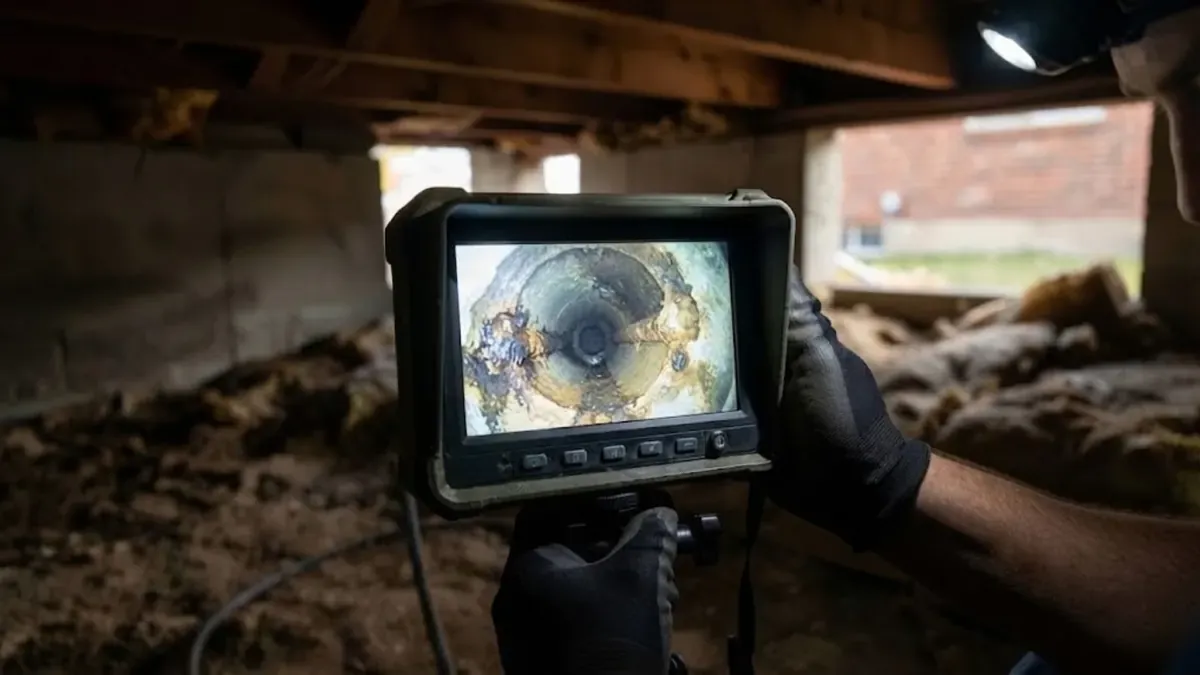
A sewer inspection in Erlanger, KY is a camera run through your main drain, from the cleanout or a pulled toilet out to the connection at the street. The plumber watches a live picture of the pipe wall, the joints and anything sitting in the flow.
It answers the question a cable machine never can: what is actually wrong in there. A clog tells you the line is blocked. A camera tells you whether roots, a sagging section, a cracked joint or a pile of grease is the reason.
Most inspections are planned. They happen before a closing, after a second or third clog, or before anyone rents a trencher.
What the camera sees that a cable never will
The camera head is about the size of a small flashlight lens, with lights ringed around it, and it rides on a stiff but bendable push rod. The plumber feeds it in through the cleanout, and the monitor shows the inside of the pipe as it moves. A built-in transmitter lets the crew trace the head from above ground with a handheld receiver.
That transmitter matters. When the footage shows a crushed section or a root mass, the plumber can mark the spot on the lawn or driveway and read the depth. A repair quote based on a marked spot is far more useful than one based on a guess about how far from the house the trouble sits.
Pipe materials show up on screen
Cast iron has a rough, flaky interior. Clay tile shows its joint every few feet. PVC and ABS look smooth and uniform. In the United States generally, homes from before the 1960s often have cast iron or clay in the sewer lateral, and newer homes lean toward plastic. A camera shows what this house actually has, which can differ from what its age suggests.
Patterns at home that call for a look inside the line
None of these prove a bad sewer by themselves. Together, or when they keep coming back, they justify a camera.
Clogs that return
The line clears with a cable, then slows again within weeks. Something in the pipe is catching debris, and the camera shows what.
Several fixtures act up together
A gurgling toilet, a tub that drains slowly and a basement floor drain that burps point toward the main line, not one trap.
A sewer smell with no obvious source
Dry traps are one cause. A cracked or separated joint leaking gas near the house is another, and only a camera can separate them.
Soggy or sunken spots in the yard
A wet patch that stays green and soft in dry weather, or a dip in the lawn over the line, can mean a broken pipe leaking into the soil.
Big trees near the line
Roots find tiny gaps at joints and enter looking for water. A camera shows how far they have grown and whether the pipe is still round.
Plans to buy or remodel
A new bathroom, an addition or a house purchase all add load or risk to a line you have never seen.
How a visit runs from cleanout to marked yard
Most inspections take a modest block of the day. Time depends on line length, access and what the camera finds on the way.
- 1
Find the access point
A two-way cleanout outside or in the basement is best. If none exists, the plumber may pull a toilet to enter the line.
- 2
Run the line clear enough to see
If standing water or heavy buildup blocks the view, the plumber clears it first. That step may be priced separately, and you hear about it before it starts.
- 3
Push the camera the full length
The head travels toward the street while the plumber watches joints, slope, cracks, roots and offsets, and notes distance on a counter.
- 4
Trace and mark problem spots
At each defect the receiver pinpoints the head above ground. Paint or a flag marks the spot, and the depth is noted for any future dig.
- 5
Go over what the camera found
The plumber explains what the footage showed and lays out plain options: leave it, clean it on a schedule, spot repair, relining or replacement.
Reading the footage: what each finding usually means
These are common readings, not verdicts. The plumber on site reads the actual picture.
| What shows on screen | Likely cause | Usual next step |
|---|---|---|
| Hair-like roots at a joint | Joint gap letting roots in | Cut roots, then plan repair |
| Standing water in a low dip | Bellied or settled pipe | Monitor, or repair that section |
| Cracked or missing pipe wall | Age, ground movement, load | Spot repair or replacement |
| Sideways step at a joint | Offset or separated joint | Dig and re-seat, or reline |
| Scale and flaking inside iron | Corrosion buildup | Cleaning, then watch the wall |
| Clear, smooth pipe | Clog was local, not the line | Fix the fixture side only |
A sag that holds a little water is not always an emergency. A fully separated joint often is, because soil and water enter the pipe.
Know what is in the pipe before you spend on it
Call to set up a camera run and a clear price. Planned visits are easy to book, and same-day appointments are available when the schedule allows.
Before you close on an older house
A general home inspector looks at the house. Most do not push a camera down the lateral. If you are buying, a separate sewer inspection can be the difference between a clean closing and an unexpected excavation bill in your first year.
Ask the seller for access to the cleanout and schedule the camera run during the contingency period. The plumber gives you footage and a plain written note on what was seen. You can then negotiate repairs, ask for a credit or walk away with open eyes.
Erlanger grew mostly in two waves, an early core around the 1887 Erlanger Proper Subdivision and the big building surge of the 1950s through 1970s. That does not tell you what pipe a specific lot has. It does mean a house from either era is old enough to be worth looking at before you buy.
Whose pipe it is between your house and the street
Sanitation District No. 1 of Northern Kentucky handles sewer service in this area. In SD1's published Backup Assistance Program policy, the property owner is responsible for a defective or failing private lateral, including any inspection needed to confirm it is clear. A camera run is how you document that. Confirm current terms with SD1.
The same policy says backups caused by a defective lateral or inadequate internal plumbing do not qualify for help. If your goal is assistance with a backup prevention device, the footage may show whether your lateral is the cause. Talk to SD1 before you spend money, since the program can change or end.
What an inspection can and cannot settle
A camera is a strong tool with limits. Knowing them keeps you from paying for a result it cannot deliver.
The camera can show
- Roots, scale, grease and debris
- Cracks, offsets and sagging sections
- Pipe material and approximate diameter
- Distance and depth to a defect
- Whether a clog is in the line or the fixture
The camera cannot show
- Hairline cracks that close when dry
- Leaks that only open under load
- Pipe on the far side of a collapse
- The condition of the municipal main
- How long the pipe will last
If a collapse blocks the head, the plumber reports how far it reached and where it stopped. That distance alone is a useful measurement.
Getting the house ready for the camera
A little prep makes the visit shorter and the footage cleaner.
- Find the cleanout cap, outside near the foundation or in the basement
- Clear plants, boxes or snow from around it
- Skip running the washer and dishwasher before the visit
- Note which fixtures have been slow and when
- Have any earlier repair paperwork handy
- Tell the plumber about trees near the line
What moves the cost of a camera run
Every house is different, so the price comes from the job, not a rate card. You hear the clear price before work starts, and any extra step, like clearing the line first, is named in advance.
Access to the line
A clean outdoor cleanout is quick. Pulling a toilet to enter the line takes longer and adds labor.
Length of the lateral
A longer run to the street means more rod, more time and more tracing.
Condition on arrival
A line full of buildup may need clearing before the camera can see anything useful.
Locating and marking
Tracing and marking the depth of a defect adds time compared with a view-only run.
Footage and write-up
A recording and a short written note for a closing or a contractor takes extra preparation.
Homeowners policies commonly exclude wear and tear and root damage, so an inspection fee is usually out of pocket. Some policies add sewer or water backup coverage. Read yours or call your agent, and keep the footage if you plan to file a claim.
Call to schedule a camera run and hear the price first.
Call (859) 900-9164Sewer Inspection Questions From Erlanger Homeowners
Most runs finish within a couple of hours once the camera is in the line. A long lateral, a heavy clog to clear first or a defect that needs tracing adds time.
A cleanout makes it faster, but it is not required. If the house has none, the plumber can usually enter through a pulled toilet, and may recommend installing a cleanout so future work is simpler.
It can show water entering from a cracked joint or a pipe wall that is wet, and the locator marks where. A tiny seep that only opens under load may not show on a dry run.
It is a smart step for any house with a lateral you have never seen, and especially an older one. Schedule it during your contingency period so the findings can shape your offer.
It tells you the condition and what repair options exist, from cleaning to spot repair or full replacement. It cannot predict how many years a sound pipe has left.
Not well. Standing water and heavy debris block the picture, so the line is usually cleared first. Clearing the main line is a separate step, and you know the price before it starts.
Ask when you schedule. A recording and a short note are useful for a closing, a contractor bid or an SD1 conversation.