
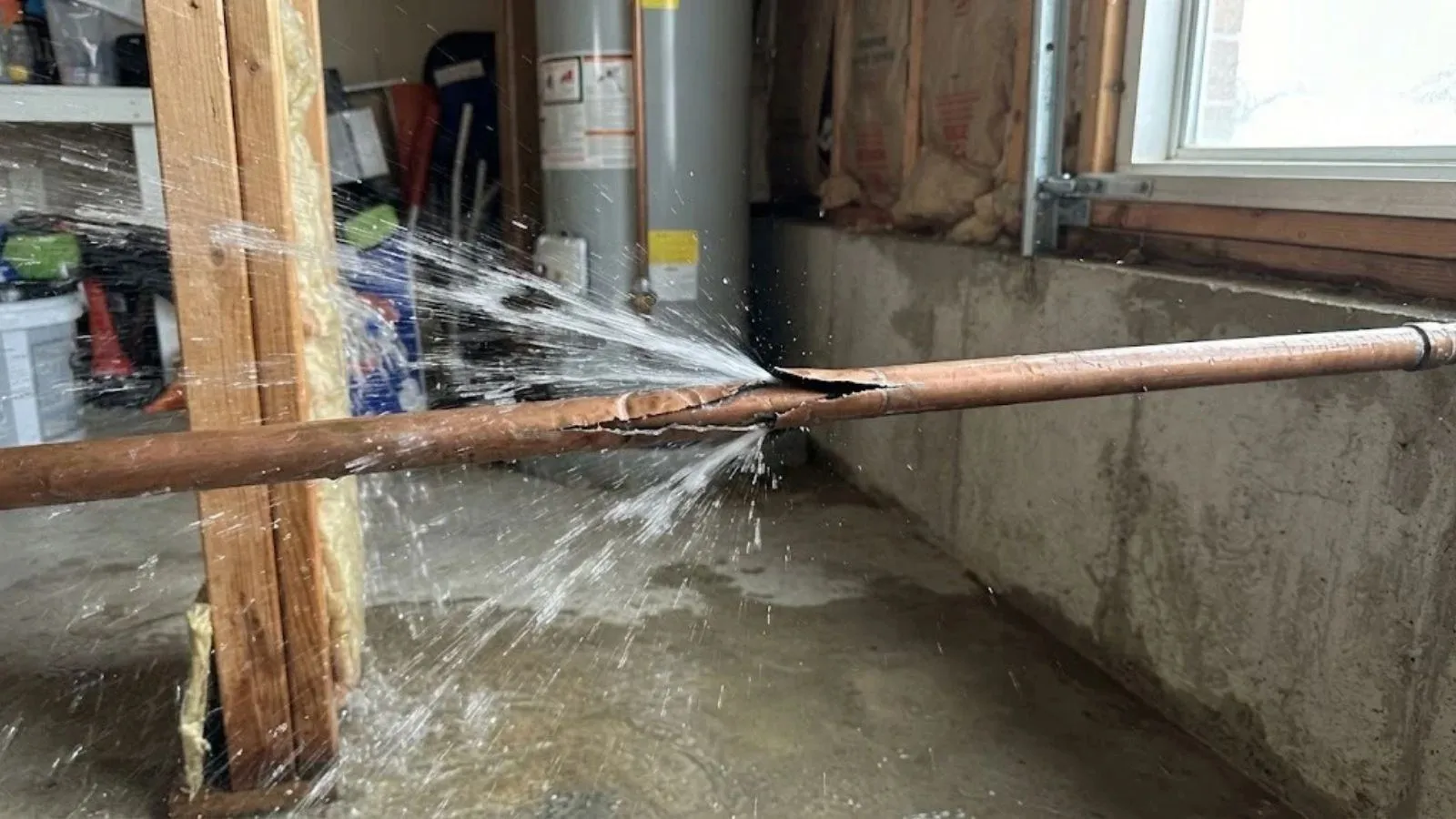
A burst pipe is an emergency from the first drip. Close the main shutoff valve, open a low faucet to drain the lines and call the 24/7 line. If water is near outlets or the panel, stay out and leave the breaker alone unless it is dry and safe to reach.
Burst pipe repair in Erlanger, KY covers the split, cracked or blown-off section of a supply line, the failed valve or fitting behind a fixture, and the follow-up check that nothing else in the system is about to let go.
How a burst usually announces itself
Some bursts are loud. Many start as a sound or a stain.
Water through the ceiling
A line in the joists or attic has split. The wet spot is often below the break, and water follows framing before it drops.
Hissing in a wall
A pressurized spray is hitting drywall. The wall may feel cool or damp, and paint starts to blister.
Sudden low pressure
Taps trickle all at once. A break upstream of the fixtures is bleeding the line, or a stop valve has failed.
A running sound with everything off
The meter keeps turning and the house is quiet except for flowing water. Check below, in the basement and around the water heater.
A burst supply valve
The small shutoff under a sink or behind a washer cracks or blows its stem. Water sprays until the main is closed.
Rust-colored water at one tap
A corroded section may be ready to give. It is not yet a burst, but it is worth an inspection.
The first ten minutes, before the plumber arrives
What you do now decides how much of the house gets wet. None of this needs tools.
Find and close the main
Turn the house shutoff clockwise. If the handle will not move, do not force it with a wrench. Tell the dispatcher so the plumber brings the right parts.
Drain the lines
Open the lowest faucet and flush an upstairs toilet. Less water in the pipes means less leaking from the break.
Protect the electrical side
Turn the water heater to off if it is electric and the tank is near the leak. Keep clear of wet outlets and cords.
Capture and move
Use buckets, towels and a wet vac if it is safe. Move furniture and valuables to dry rooms, and take photos for your records.
Ways a burst section gets repaired
The right fix depends on the pipe material, where it split and how many other spots look weak.
| Repair method | Fits when | Trade-off |
|---|---|---|
| Cut and coupling | One clean split in copper or PEX | Fast, needs good access |
| Press or crimp fittings | Short damaged run, tight space | Needs sound pipe on both ends |
| Replace a run | Several weak spots in one line | More opening, fewer repeat calls |
| New stop valve | Cracked shutoff at a fixture | Quick, often same visit |
| Reroute through attic or wall | Line is in a hard-to-reach spot | Costs more now, easier later |
| Replace the service line | Break in the yard line to the meter | Needs digging and a permit |
A single split in an otherwise sound pipe is a repair. Repeated splits in old galvanized or pitted lines point toward replacement.
Freeze splits: why the pipe breaks and when it shows
Water expands as it freezes, and the pressure builds in the sealed section between the ice plug and the closed tap. The pipe usually splits there, not at the ice itself. The break often stays hidden until the ice melts, which is when water suddenly appears.
That is why a pipe that froze overnight can look fine at breakfast and flood by noon. If a line froze and thawed, close the main and check walls, the crawlspace and any exterior wall before turning water back on.
Water is moving. So should the call.
Close the main, then reach the line. A licensed plumber can stop the damage and price the fix before work starts.
If the pipe is frozen but has not split yet
A pipe that gives only a trickle may be iced up. Handled right, it can thaw without breaking. Handled wrong, it can start a fire or a flood.
- 1
Open the faucet
Leave the tap on so melting water has a place to go and pressure can ease.
- 2
Apply gentle heat
Use a hair dryer or warm towels, working from the faucet toward the frozen section. Never use an open flame or a torch.
- 3
Check the whole line
While thawing, look for wet insulation, bulges or drips along the pipe. A swelling means a split is coming.
- 4
Close the main if you see water
A leak that appears during thaw means the pipe has failed. Shut off the main and call.
- 5
Call if you cannot reach the freeze
A line inside a finished wall or under a floor is better left to a plumber with a thermal camera and the right tools.
After the pipe is fixed: drying, damage and who does what
Plumbers stop the water and fix the pipe. Drying walls, pulling wet insulation and replacing drywall or flooring is a different trade. Call a restoration company soon, since wet materials can grow mold within a couple of days.
Photograph the damage before anything moves and keep the old pipe section if you can. Your insurer may want both. We will leave the area safe, point out which walls we opened and describe what the plumbing repair did and did not include.
A pipe repair is not always a permit job
Under Kentucky's 815 KAR 20:050, repairing leaks, cocks or valves does not need a plumbing permit. A new or replaced water service does, as does moving fixtures or replacing a water heater. A licensed master plumber can pull the permit. Call 811 before digging up any yard line.
Erlanger homes, lines and what age can tell you
Erlanger's core dates to the late 1800s, and the city added housing quickly in the 1950s, 1960s and 1970s. In the US generally, homes from before about 1960 often have galvanized steel supply lines, and copper became common after that. A camera or pipe inspection shows what this house actually has.
Why that matters when a pipe bursts: old galvanized lines corrode from the inside and can fail in more than one place. If the plumber finds heavy corrosion, a repipe of the affected run may cost less than a string of repairs. Ask for both options, side by side.
What shapes the bill on a burst pipe call
Emergency work is priced by what has to be fixed, not by how scary the water looks. You hear a clear price before work starts, and any added work is explained first.
Where the pipe is
An exposed basement line is quick. A pipe inside a finished wall or under a slab takes more cutting and patching.
Pipe material and size
Copper, PEX and galvanized each need different fittings and tools. Larger lines mean larger parts.
Length of damaged run
One split is a small job. Several weak spots may mean replacing a whole run.
Time of the call
Nights, weekends and holidays may use after-hours rates. We tell you before we start.
Valves and fittings
Replacing a corroded shutoff while the line is open often prevents a second call.
Many homeowners policies cover sudden pipe bursts and the resulting water damage, but not slow leaks or wear. Call your insurer promptly. Keep photos, the failed pipe section and our written description of the repair for your claim.
Call the 24/7 line and describe where the water is.
Call (859) 900-9164Burst Pipe Repair Questions From Erlanger Homeowners
Yes, the line is staffed around the clock and same-day service is offered when available. Close the main shutoff, drain the lines and call with what you see.
Usually where the water line enters the house, in a basement, utility room or near the water heater. A second valve sits at the meter outside. Find both now, before you need them.
Yes, once the plumber has pressure tested the repair and flushed the lines. Open taps slowly to purge air, and check for new drips at nearby fittings.
Sudden bursts are often covered, while wear and slow leaks usually are not. Policies differ, so call your insurer and ask about deductibles and what documents they want.
Open the faucet and warm the pipe gently with a hair dryer, starting near the tap. Never use a flame. If you see water or cannot reach the freeze, call a plumber.
Shut off the main and call. The plumber locates the split with a moisture meter or thermal camera so the opening is as small as possible.
No. Plumbing repair covers the pipe. Drying, drywall and flooring are handled by restoration and finishing trades. We tell you what was opened.
A single clean split in good pipe is a patch. Several breaks or visible corrosion usually favor replacing that run, which the plumber can price both ways for you.