
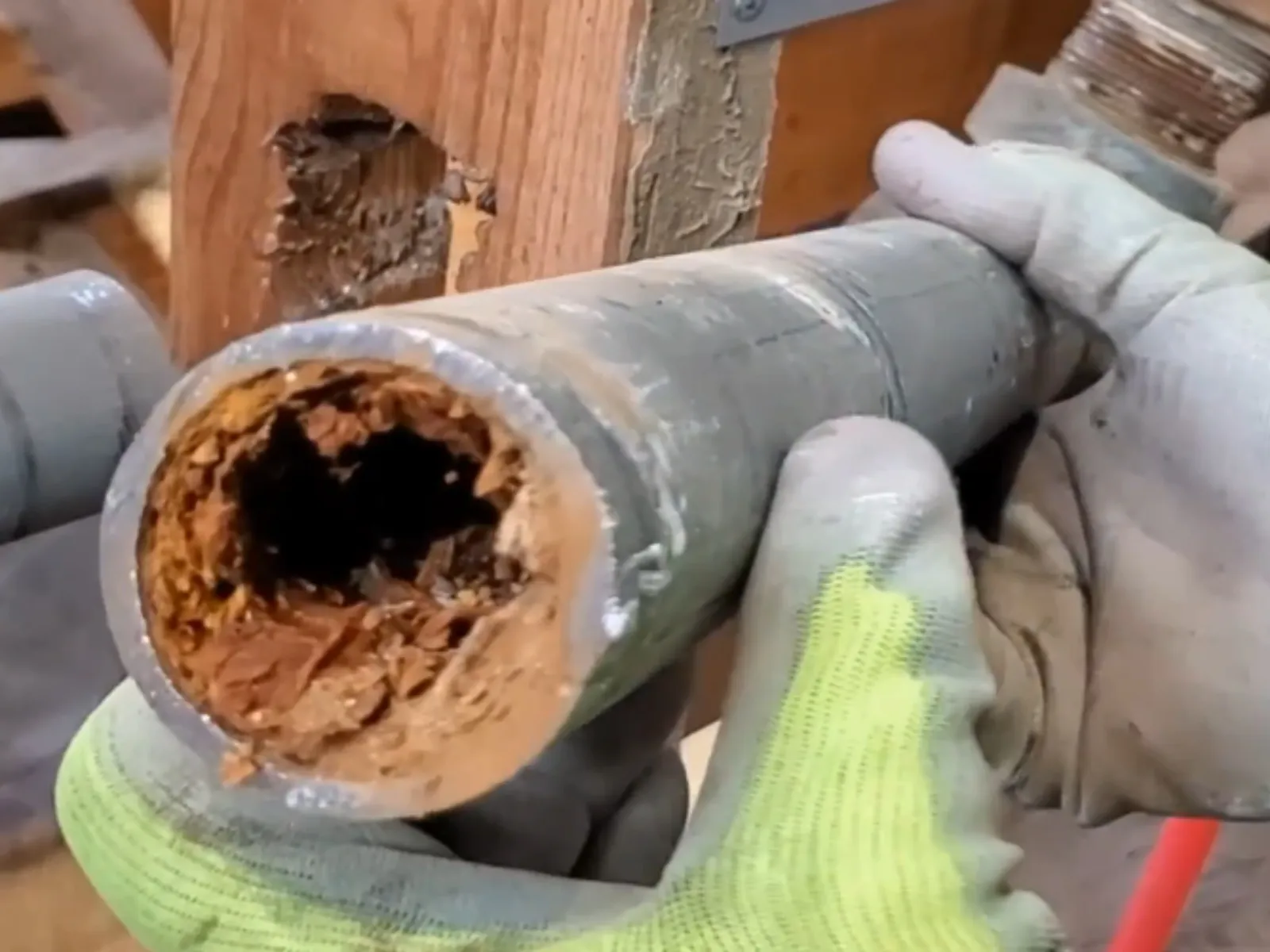
In Erlanger, KY, repiping means replacing the water supply lines inside a house, the pipes that carry hot and cold water to every tap, tub and appliance. It is not the same as the drains. A repipe is planned work, usually done when repairs have started to pile up faster than the pipes can hold.
The decision is rarely obvious. One leak is a repair, and three leaks in one year may be a pattern. This page explains the signs, the materials and what the work involves, so you can decide with real information.
How worn supply pipes announce themselves
Most owners do not search for repiping at first. They notice something odd at the faucet and keep a list in their head.
Brown or orange water after sitting
Rust flakes from inside steel pipes show at the first draw of the morning. If the color clears after a minute, the pipe is the likely source.
Pressure that fades at the far fixtures
Mineral buildup narrows old pipe from the inside. The shower weakens first, then the kitchen, even when the street pressure has not changed.
Pinhole leaks in different spots
A weeping spot on a copper line that has been patched once will often have a neighbor. Patches that keep multiplying mean the whole run is thin.
Stains on walls and ceilings
A damp patch that dries and returns, with no roof or fixture above it, can be a slow leak behind the finish.
A water bill that creeps up
The meter keeps turning with every tap off? That points to a hidden leak, and a plumber will look at the lines before suggesting a repipe.
Metallic taste or cloudy water
Corroded fittings can add taste or sediment to the tap. A plumber can rule out the source.
The pipes behind the wall, by building era
Different decades favored different supply materials in the United States. This table shows what homes of each period were commonly plumbed with, not what any single house has.
| Era the house was built | Common supply pipe | Typical late-life problem |
|---|---|---|
| Before about 1960 | Galvanized steel | Internal rust, narrowing, weak flow |
| Mid-century onward | Copper | Pinholes, pitted elbows, failing solder |
| Late 20th century, some homes | Gray plastic known as polybutylene | Splits at fittings with no warning |
| 1980s onward, some homes | CPVC | Brittle with age, cracks at joints |
| More recent work | PEX | Few issues, except damage from UV |
A camera or a pipe inspection shows what this house actually has. Remodels mix materials, so a house from one era can have pipes from three.
What 1960s Erlanger houses may be hiding inside the walls
Erlanger's growth peaked in the 1950s, 1960s and 1970s, and the city led the Cincinnati metro area in new construction for three years in the 1960s. Houses from that stretch were commonly plumbed with galvanized steel or copper, and later repairs may have added newer sections. That mix is the reason a repiping quote starts with an inspection.
Older homes in the core near Historic Erlanger, which grew from the 1887 subdivision, are even more likely to have been repaired and re-routed over time. Ask the plumber to open a few access points in the basement or crawlspace and in a closet wall. What shows there is better evidence than the house's age.
PEX or copper: the honest trade-offs
Both materials are reliable when installed properly. The choice comes down to the house, the budget and how you feel about each.
PEX tubing
- Flexible, so it snakes through walls with fewer cuts
- Fewer joints and fewer leak points
- Less demolition in most houses
- Must not sit in direct sunlight
- Fittings are made of metal or plastic crimp rings
Copper tubing
- Rigid and long-proven in service
- Handles heat and sun without issue
- More joints to solder or press
- Can pit in aggressive water over decades
- Usually costs more in parts and labor
Test your tap, and ask NKWD for its annual water quality report. The plumber can then explain whether the water chemistry favors one material.
Third pinhole leak this year?
A pattern of leaks is worth a proper look at the lines. Call to schedule a walk-through and written scope.
How a repipe unfolds, from first walk-through to turning the water back on
A good repipe is organized in stages so the house stays usable. Here is the usual order.
- 1
Walk-through and inspection
The plumber traces the lines, checks the water main and meter area, and tests pressure to learn what needs replacing.
- 2
Written scope and price
You see which fixtures, valves and runs are included and what is excluded, before work is scheduled.
- 3
Permit
A licensed master plumber can pull the plumbing permit from the state Division of Plumbing before the first pipe is cut.
- 4
Rough-in
New lines are run through walls, floors and the attic, with new shutoffs at the fixtures. Most of the pipe is placed before the old pipe is removed.
- 5
Cutover and testing
Water is off for part of a day while the old lines are capped and the new system is connected. The plumber then pressure-tests every run and checks every fitting.
- 6
Final inspection
Ask how the permit inspection is scheduled. Wall patching and painting are separate trades.
Permits, licensing and the shortcut that causes trouble
Kentucky requires a plumbing installation permit from the Department of Housing, Buildings and Construction before plumbing work, under KRS 318.134. The rules in 815 KAR 20:050 list new plumbing, moved fixtures and a replaced water service among the jobs that need one, while repairing a leak does not. A whole house repipe is far larger than a repair, so plan on a permit.
A licensed master plumber can pull the permit. A homeowner living in the house may pull one with an affidavit, if they do all the work themselves and follow code. The affidavit warns that using unlicensed workers can lead to prosecution under KRS Chapter 318, so check any plumber's license with the Division of Plumbing.
A repipe is not a drain job and not a service line job
A repipe replaces supply lines inside the building. The water service line between the meter and the house, and the drain and sewer lines, are different systems with their own work. A plumber should be clear about which are in the quote.
Before you ask for a repipe quote
A few minutes of notes make the quote more accurate and the conversation shorter.
- Write down where leaks, stains and low pressure have shown up
- Note the number of bathrooms and kitchens
- Find the water main shutoff and test that it closes
- Check what material is visible in the basement or crawlspace
- Decide whether the water heater will be replaced at the same time
- Ask for the scope in writing, including patching and painting
What drives the cost of repiping a house
No two houses repipe the same way, so a number without a look at the house is a guess. The plumber walks the lines first and gives you a clear price before work starts.
Size and layout
More bathrooms, more floors and longer runs mean more pipe, more fittings and more hours.
Pipe material
PEX and copper differ in material cost and in installation time. The water chemistry and your preference also play a part.
Access to the lines
Open basements and crawlspaces are quick. Finished walls need openings and patching, which take longer.
Number of fixtures and valves
Each fixture gets new shutoffs, and older homes sometimes need extra valves or a new main.
Permit and inspection
The permit process and inspection add steps, and it is part of the scope you receive in writing.
Homeowners policies commonly treat sudden water damage differently from the cost of replacing worn pipes, which is usually treated as maintenance. Ask your insurer before work, and keep the inspection notes because they document the condition of the old lines.
Call to schedule a walk-through and learn the price before work is booked.
Call (859) 900-9164Repiping Questions From Erlanger Homeowners
A single leak on an otherwise sound line is a repair. Repeated leaks in different places, discolored water and low pressure at several fixtures point toward replacement.
A plumber who inspects the lines can tell you how much good pipe is left.
It depends on the house. Open framing goes faster than finished walls, and the work is organized so that the water is off for a limited time on cutover day.
The plumber gives you a plan for your home. No finish date is promised until the lines have been inspected.
Usually yes. The work is phased, and the plumber plans to restore water at the end of each work day where possible. Expect to lose water for part of at least one day.
Expect dust near wall openings, and cover furniture close to work areas.
Not always. PEX is flexible and can be fished through existing cavities, and a basement or crawlspace gives access to many runs from below. Some openings are still needed, usually in closets, behind fixtures and at stud bays.
Patching and painting are done by other trades.
It can be, if the pipes are failing and an inspector will flag them. If the pipes are sound, repairs are cheaper. Ask the plumber what shape the lines are in.
A written scope and a permit sign-off help buyers and their inspectors see what was done.
That is the water service line, and it is a separate job from repiping the inside of the house. A replaced water service needs its own permit under 815 KAR 20:050, and 811 must be called before anyone digs.
If the whole system is suspect, the plumber can scope both.