
The U.S. Department of Energy says tankless water heaters commonly last 20 years or more, while storage tank units run about 10 to 15 years. That is a fair planning number for a unit that is installed correctly and looked after. It is not a promise for any single machine.
In practice, the gap between a 12-year tankless and a 22-year tankless usually comes down to three things: mineral scale inside the heat exchanger, how hard the unit is worked each day, and whether anyone ever flushed it. The rest of this post covers each of those and how to tell where your unit stands.
What the 20-year figure really assumes
A lifespan estimate describes the body of the unit. The heat exchanger, the burner or elements, the control board and the casing can last for decades. The parts that wear sooner are the ones that move, spark or sense: the flow sensor, the igniter, the exhaust fan, the water inlet screen and the temperature sensors.
That matters because many tankless units are retired early for a part that could have been replaced. A failed igniter or a clogged inlet screen can look like a dead heater. A plumber who checks the error code first can often separate a cheap fix from a true end of life.
The figure also assumes the unit was sized for the house. A heater that is too small runs at full fire every time someone showers, and constant maximum firing wears the burner and the exchanger faster than a unit with room to spare.
Which parts wear out first and why
Tankless units are built from a handful of subsystems, and each one ages differently. This table shows the usual pattern, so you know what a repair visit is likely to involve.
| Part | What wears it | How it shows up |
|---|---|---|
| Heat exchanger | Mineral scale and hard use | Slow flow, hot and cold swings |
| Inlet water screen | Sediment and debris | Weak hot water pressure |
| Flow sensor | Scale and fine grit | Unit will not fire at low flow |
| Igniter or electrodes | Repeated heating cycles | Clicking, then an error code |
| Exhaust fan | Dust, lint and motor wear | Noise, venting error codes |
| Condensate drain | Acidic condensate, blockage | Water pooling at the base |
None of these are tied to the age of the whole unit. A fan or sensor can fail in year six and be replaced, and the heat exchanger can keep going for another fifteen.
Signs your tankless heater is aging
Wear rarely arrives all at once. These are the early signals that tend to show up months before a complete shutdown.
Hot water turns lukewarm
Scale inside the exchanger insulates the water from the flame, so output drops even though the unit runs.
Cold sandwich effect
Hot, then a cold burst, then hot again at one tap often points to a dirty flow sensor or a sizing limit.
Repeating error codes
The same code coming back after a reset means something real is failing, not a one-time glitch.
Louder than it used to be
Kettle-like rumbling is usually scale. Rattling or whining often means the exhaust fan is wearing.
Longer wait for hot water
If the delay at the tap keeps growing, the exchanger may be restricted or the unit may be shutting down early.
Moisture near the unit
A damp base can come from a loose fitting or condensate line. A weeping exchanger is a different and more serious matter.
Water reports, permits and older Erlanger homes
Federal rules require community water systems to publish an annual water quality report. Check your water bill to confirm who supplies your home, then ask that supplier (Northern Kentucky Water District is one) for its report. Pair it with a test of your own tap. The same steps work in nearby Elsmere and Edgewood.
Kentucky's plumbing rule, 815 KAR 20:050, requires a permit for installing or replacing a water heater. A licensed master plumber can pull that permit. If a plumber offers to swap your unit with no permit, treat that as a reason to ask questions, since unlicensed installs can lead to trouble later.
Erlanger added much of its housing in the 1950s through the 1970s, and a lot of those houses started life with a tank heater. If your home is from that era, ask whether the existing gas line and venting can handle a tankless unit, because a camera or line inspection shows what this house actually has.
Source type: NKWD annual water quality report guidance, Kentucky 815 KAR 20:050, City of Erlanger growth eras
A yearly flush in six steps
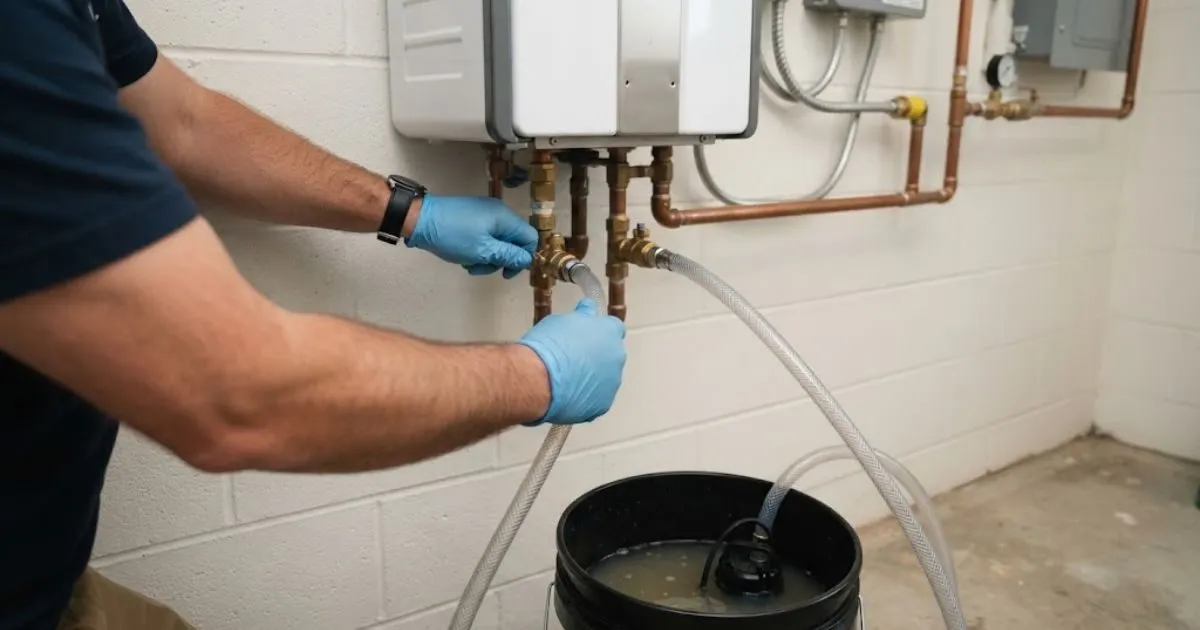
Flushing is the single habit that does the most for lifespan. Most units with isolation valves can be flushed in under an hour. If yours has no service valves, a plumber can add them so the job is easy every year.
- 1
Power down the unit
Turn off the electrical supply and close the gas valve to the heater. If you ever smell gas, leave the building and call the gas utility or 911 from outside before doing anything else.
- 2
Close the water isolation valves
Shut the cold inlet and hot outlet valves, then open the service ports to release the pressure.
- 3
Connect a small pump and hoses
Run one hose from the pump to the cold service port and another from the hot port into a bucket.
- 4
Circulate a descaling solution
White vinegar is common, but follow the unit maker's instructions for the type and time. Thirty to sixty minutes is typical.
- 5
Rinse with clean water
Flush the solution out thoroughly, then clean the small inlet screen under running water.
- 6
Restore service and test
Reopen the valves, restore gas and power, and run hot water at a tap to confirm normal operation.
Testing your tap before you blame the heater
Mineral content is the biggest outside factor in how fast scale builds. Hard water leaves calcium and magnesium deposits on any hot surface, and a tankless exchanger has very narrow passages that clog sooner than a big tank does.
You do not need a lab to get a rough picture. Buy a simple hardness test strip kit and test a cold tap, or look for white crust on your faucet aerators and showerheads. Heavy crust means the heater sees the same minerals every day.
If the numbers come back high, a flush every six months may suit your house better than once a year. Some homeowners add a scale inhibitor or softener ahead of the heater. A plumber can discuss which option fits your plumbing and budget.
Repair the old unit or replace it
Once a tankless heater passes the 15-year mark, the question comes up with every service call. These two lists show how the decision usually breaks down.
Repair tends to make sense when
- The failing part is a sensor, igniter, fan or screen
- The heat exchanger is clean and not leaking
- The unit still meets your household hot water demand
- Parts are still available for the model
- Error codes are isolated, not constant
Replacement tends to make sense when
- The heat exchanger is leaking or badly scaled
- Repairs are happening more than once a year
- The unit is undersized after a remodel or added bathroom
- Parts for the model are no longer sold
- The venting no longer matches current requirements
A plumber can read the codes and inspect the exchanger before you decide. For a leaking exchanger, a new tankless installation is usually the sounder path than patching.
Quick Answers on Tankless water heater lifespan
The U.S. Department of Energy says tankless units commonly last 20 years or more. Real lifespan depends on water quality, how often the unit runs, and whether it gets flushed on schedule.
Yearly is the usual starting point, and it is the best single habit for lifespan. In homes with heavy mineral buildup, every six months is often a better rhythm. Your unit's manual lists the maker's own interval.
It can be, if the problem is a sensor, igniter, fan or screen and the heat exchanger is sound. If the exchanger is leaking or heavily scaled, repair money is better spent on a planned replacement before a failure forces a rushed one.
Scale from unflushed hard water, an undersized unit running at full fire all day, blocked venting, and ignoring error codes are the usual causes. Poor installation, such as wrong gas line size, also shortens life.
Many homeowners do, if the unit has isolation valves and they follow the maker's instructions. Gas and power must be off first, and any gas smell means leave and call the gas utility or 911. A plumber can handle the job or add valves for you.