
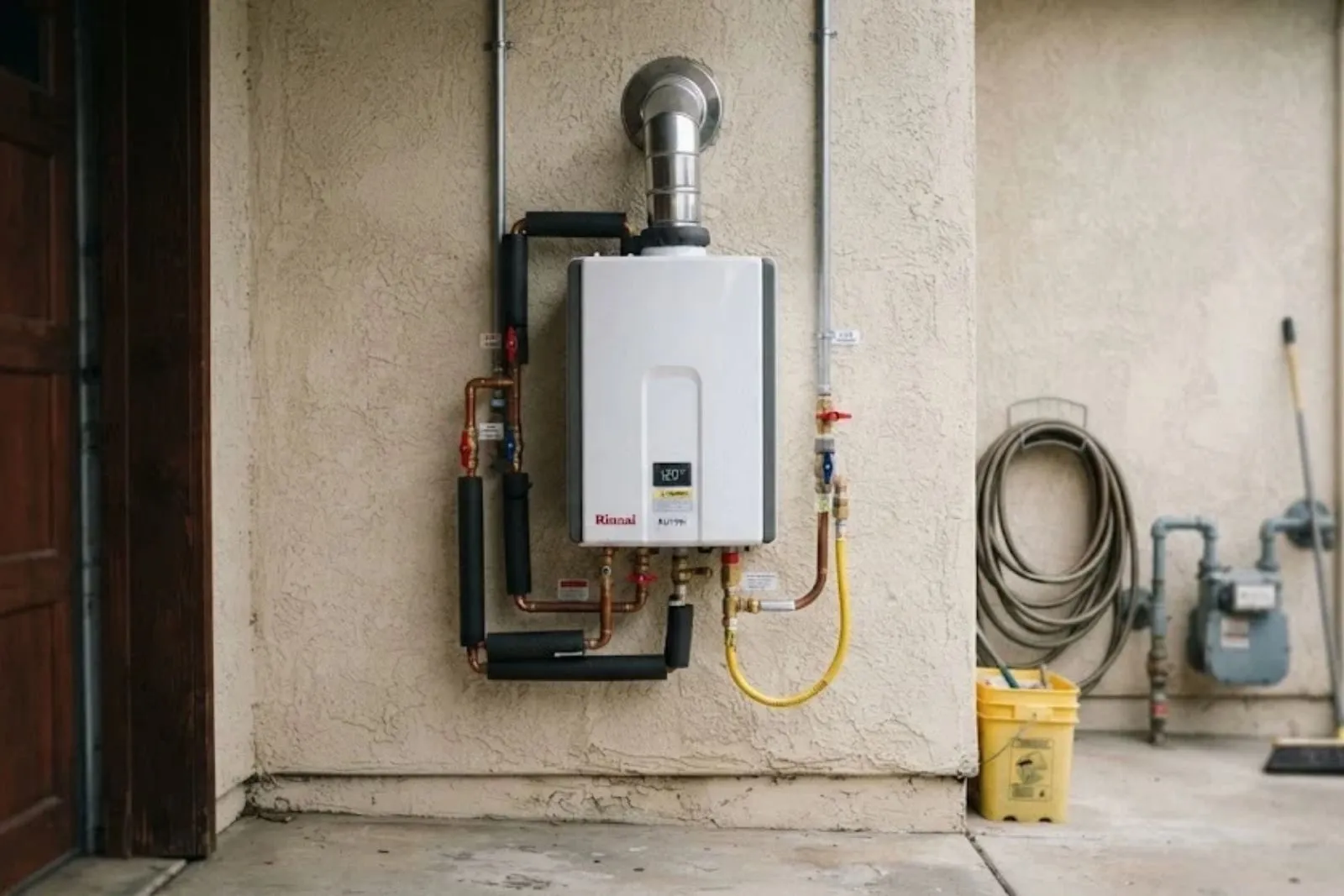
A tankless water heater in Erlanger, KY is an on-demand unit with a heat exchanger that fires only when a hot tap opens. There is no 40-gallon reservoir to run dry, so hot water is limited by flow rate, not by tank size.
Homeowners usually come here for one of three reasons. An aging tank needs replacing, hot water never keeps up, or an existing tankless unit is throwing errors and needs a flush. Each has a different answer, and we separate them below.
Why a Tankless Unit Is Sized by Flow, Not Gallons
A tank is described by how much water it holds. A tankless unit is described by how many gallons per minute it can heat and by how many degrees it can raise the temperature at that flow. Cold incoming water in winter is colder than in summer, so the same unit delivers less hot water in January than in July.
To size one, add up the gallons per minute of the fixtures that may run together. A shower, a kitchen tap and a running dishwasher can overlap. If the unit cannot cover the peak, the choice is a larger unit, two units or a habit change.
A quick sizing walk-through
The plumber lists your fixtures, their flow rates and the coldest water temperature you expect. The answer is a flow figure at a specific temperature rise, and that figure picks the model.
Sizing Inputs the Plumber Works Through
Every row below changes which unit fits your house. None of it is guesswork once the numbers are on paper.
| Input | What it affects | How it is checked |
|---|---|---|
| Peak fixtures running at once | Required flow in gallons per minute | Fixture list and household habits |
| Incoming water temperature | Temperature rise the unit must deliver | Measured at a cold tap in winter if possible |
| Target output temperature | Heat the unit must add | Usually 120F per DOE suggestion |
| Gas line size and length | Whether the unit can fire at full rate | Pipe sizing against the unit's input rating |
| Vent length and routing | Which vent material and route is allowed | Manufacturer limits and code |
| Water quality | Scale buildup and service frequency | Test your tap and read the water quality report |
Ask Northern Kentucky Water District for its annual water quality report if you want to see what the heat exchanger will live with.
Signs Your Hot Water Setup Is Struggling
Most people do not search for tankless until something has gone wrong with a tank or with an existing on-demand unit. These are the symptoms that point toward it.
Hot water fades in a long shower
A tank that runs out mid-shower is the classic reason to look at tankless. The fix is continuous heating, if the gas supply can handle it.
A burst of cold between hot draws
On tankless units this cold gap comes from the unit shutting off and restarting. Recirculation or a small buffer can reduce it.
Lukewarm output on a unit that used to work
A scale-coated heat exchanger transfers heat poorly. The unit works harder, throws temperature errors and loses efficiency.
Error codes on the display
Codes can mean flame problems, vent blockage, flow sensor trouble or overheating. They are a starting point for diagnosis, not a final answer.
Tank getting old and rusty
Rust-colored water or a leaking tank is a sign to compare tank replacement with a tankless conversion.
Thinking About Going Tankless?
Call to talk through your fixtures and gas supply. A plumber can tell you whether a unit fits and what it needs.
Descaling and Flushing a Tankless Heater
Tankless units use narrow passages inside the heat exchanger, so mineral scale can build up and choke flow. A flush dissolves it.
- 1
Isolate the unit
Service valves on the hot and cold lines are closed, and the pressure relief is eased so the unit can be drained safely.
- 2
Connect a pump and hoses
A small pump circulates a descaling solution through the heat exchanger in a loop.
- 3
Circulate for the right time
The solution runs long enough to dissolve scale. Heavy buildup takes longer.
- 4
Rinse and clean the filter
Fresh water flushes out the solution and loosened scale. The inlet filter screen gets cleaned or replaced.
- 5
Restart and test
The unit is re-pressurized, fired and checked for temperature, flow and error codes.
Honest Drawbacks Before You Commit
Tankless is a good fit for some houses and a poor fit for others. Both sides deserve a hearing.
What tankless does well
- Heats continuously with no tank to deplete
- Takes less floor or wall space
- Can last 20 or more years per the DOE
- No standby tank to keep hot
- Easy to expand with a second unit
What to weigh against it
- Higher upfront cost and installation work
- Often needs a larger gas line and new vent
- Needs electricity for controls on most units
- Annual flushing is part of ownership
- Minimum flow means very low draws may not fire
The U.S. Department of Energy says tankless units commonly last 20 or more years, compared with 10 to 15 for storage tanks. That longevity depends on keeping scale under control.
Gas Line and Venting: Where the Real Work Hides
A tankless gas unit often fires at a much higher input than a tank burner. The existing gas pipe may be too small or too long to feed it, and that is the most common surprise in a conversion. A plumber measures the run and sizes the pipe against the unit's rating before quoting.
Venting is the second surprise. Many high-efficiency units use plastic vent pipe that exits through a wall instead of a chimney, and the route has length and termination limits. If the plan changes the vent, a permit and a careful inspection of the path are part of the job.
If you ever smell gas near any water heater, leave the building and call the gas utility from your bill or 911 from outside. Do not try to find the leak yourself.
Tankless Conversions in Northern Kentucky Homes
Erlanger's 1950s to 1970s subdivisions often have small gas lines that were sized for a tank burner. A conversion may need a larger line from the meter, so a pipe inspection and a sizing check are worth doing before you buy a unit. Ask the plumber what the existing line can carry.
Kentucky's 815 KAR 20:050 requires a plumbing permit for installing or replacing a water heater, and the plumber handles it. Customers from Florence and other nearby towns get the same process. The 24/7 line is open if an old tank fails while you are still planning.
Why Tankless Jobs Are Priced Differently
Tankless jobs run longer and touch more of the house than a tank swap. A clear price comes first, built from these pieces.
Unit capacity
Higher flow and temperature rise ratings cost more, and a very large household may need two units.
Gas line upsizing
A longer or larger gas run adds pipe, fittings and labor.
Vent and condensate work
New wall penetrations, vent pipe and a condensate drain for high-efficiency units add to the job.
Electrical needs
Most units need a nearby outlet or small circuit for controls.
Service valves and flush kit
Isolation valves make future flushing possible and are worth including at install.
Tankless is almost always an elective upgrade, so homeowners insurance does not normally cover it. If the unit fails because of a sudden leak, ask your carrier about damage. Some utilities or manufacturers run efficiency programs, so check the current terms yourself.
Call to talk through your gas supply, fixtures and goals and get a clear price before work begins.
Call (859) 900-9164Tankless Water Heater Questions From Erlanger Homeowners
It depends on your gas supply, your household's peak hot water use and how long you plan to stay. The DOE says tankless units commonly last 20 or more years, which helps the math, but upfront cost and gas line work are higher.
Most makers suggest flushing about once a year, and more often with scale-prone water. Test your tap and look at Northern Kentucky Water District's annual water quality report to judge your water. Flushing is a service call we can schedule.
Usually yes, if it has service valves. If the valves are missing, the plumber can add them during the visit. Units that are not accessible or that have heavy scale may need extra time.
Often. Tankless units fire at a higher input than most tank burners, so the existing gas pipe may be undersized. The plumber checks pipe size and length before quoting, and a permit may be involved.
Brief cold gaps between hot draws are common when the unit shuts off and restarts. Recirculation lines, a small buffer tank or adjusting how fixtures are used can reduce it.
Yes, if the unit's flow rating covers both at your coldest incoming water. If it does not, you will see cooling at one or both. Sizing against peak flow prevents that.