
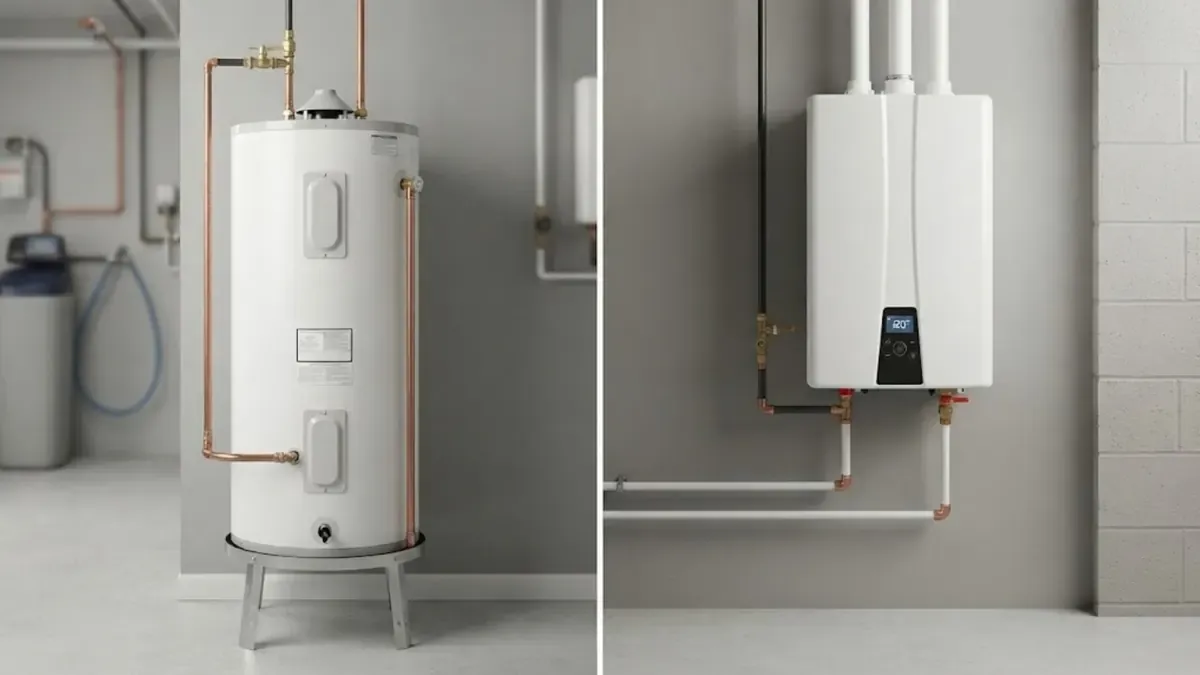
A tank water heater stores and keeps a set volume of hot water ready. A tankless heater heats water only while a tap is open. Tankless units last longer and take less room. Tank units cost less to install and handle simple setups well. The better pick depends on your household, your fuel and your existing lines.
The U.S. Department of Energy says tankless units commonly last 20 or more years, and storage tank units last 10 to 15 years. That gap matters, but it is only one of several factors. The sections below show what else to weigh and where each type falls short.
Side by side: how the two types compare
Use this table as a first pass. Individual models vary, so treat the rows as general patterns.
| Feature | Tank heater | Tankless heater |
|---|---|---|
| Hot water supply | Limited by tank size, then recovers | Continuous while flow stays in range |
| Typical lifespan (DOE) | 10 to 15 years | 20 or more years |
| Space | Floor space for a tank | Wall-mounted, much smaller |
| Installation work | Often a like-for-like swap | May need gas, venting or electrical upgrades |
| Upfront cost factors | Simpler parts and labor | Unit, venting, gas sizing and labor |
| Upkeep | Tank flush and anode check | Periodic descaling flush |
| Power outage | Gas models still heat water | Needs electricity to run |
None of this settles the question alone. A small tankless unit on an oversized demand loses to a well-sized tank every time.
How each system makes hot water
A tank heater, the usual choice for a standard water heater install, holds a large volume of water, often 40 to 50 gallons in a home, and keeps it at a set temperature. Gas models use a burner under the tank. Electric models use heating elements. When a tap opens, hot water leaves from the top and cold water enters at the bottom.
A tankless heater has no storage. When a tap opens, a flow sensor starts the burner or the elements, and water is heated as it passes through a heat exchanger. The unit can only heat so much water per minute, which is why sizing matters.
The big difference is the point where the limit shows up. A tank runs short when the stored hot water is used up. A tankless unit runs short when too many fixtures draw at once.
Where each type earns its keep
Each system has real strengths and real weak spots. Here is the honest version.
Tank water heater
- Handles a simple swap with the lines already in place
- Delivers a big first burst of hot water after a long rest
- Costs less to buy and install in most homes
- Wears out sooner, and a failing tank can leak
- Loses some heat while it stands full
Tankless water heater
- Heats on demand, so it never runs out while flow stays in range
- Lasts longer and takes little wall space
- May need larger gas lines, new venting or a dedicated circuit
- Needs periodic flushing where scale builds up
- Can give a brief cold stretch between uses
Neither is the right answer for every house. A large family with showers running together needs a tankless unit sized for that, or a tank with room to recover.
Permits and water supply notes for Kenton County installs
Kentucky's 815 KAR 20:050 says a permit is required to install or replace a water heater. A licensed master plumber can pull it. A homeowner may pull a permit for a home they occupy, but only under strict conditions and doing all the work personally. For a gas or vented unit, most owners hand it to a plumber.
Northern Kentucky Water District supplies retail customers across Kenton, Boone and Campbell counties, and your bill confirms who serves your address. Ask NKWD for its annual water quality report and test your own tap before choosing, since scale affects how often a tankless unit needs a flush.
Families in Edgewood and Florence weigh the same trade-offs. Start with your hot water habits, then let the plumber check the gas line, vent path and available space.
Source type: Kentucky 815 KAR 20:050 and Northern Kentucky Water District (NKWD) filing
Questions that decide it for most households
Answer these in order and the choice usually gets clear.
How many fixtures run at once?
Two showers and a dishwasher in the morning is a bigger load than one shower. Total flow is what a tankless unit must meet.
What fuel do you have?
Gas tankless units need enough gas supply and proper venting. Electric tankless units pull a lot of power and may need a new circuit or panel space.
Where would it go?
A tank needs floor space and a drain nearby. A tankless unit hangs on the wall but still needs a vent path or a cabinet clearance.
How long will you stay?
A longer stay spreads a higher upfront cost across more years. A shorter stay favors a simple swap.
How is your water?
Scale shortens the life of any heater and clogs a tankless heat exchanger faster. A test of your tap tells you what to expect.
How to size and plan the switch
Planning is where tankless projects succeed or struggle. These are the steps in order.
- 1
List your peak hot water uses
Count the fixtures that run together on a busy morning and note the highest flow among them.
- 2
Check the temperature rise
Tankless sizing depends on how much the unit must heat incoming cold water. Colder inlet water needs a bigger unit in winter.
- 3
Check gas supply and venting
A tankless unit often needs a larger gas line and a different vent type than a tank. The plumber measures both before quoting.
- 4
Plan the shutoffs and drain
Isolation valves make later flushing simple. Ask for them to be added during the install.
- 5
Pull the permit
Installing or replacing a water heater needs a permit in Kentucky. A licensed master plumber can pull it.
The tankless downsides people rarely hear
Tankless units often need more infrastructure than the old tank did. A bigger gas line, a stainless or polypropylene vent run, a new circuit or an added condensate drain can all show up on the quote. Those upgrades are why a tankless install costs more than a tank swap.
Water that sits between the heater and the tap cools off. A tankless unit still has to wait for hot water to travel through the pipe. You may also notice a brief cold stretch if you shut a tap off and turn it on right away.
Scale builds on the heat exchanger and lowers flow over time. A yearly flush with a descaling solution and the isolation valves keeps this under control. Skip it and the unit's life shortens quickly.
Gas, venting and when to leave the house
If you smell gas near any water heater, leave the building at once and call the gas utility or 911 from outside. Do not flip switches, light anything or call the plumber first. Gas work on a water heater belongs to a licensed plumber.
Tank heaters vent through a flue pipe that rises to a chimney or a wall. Tankless gas units often vent horizontally through a wall in a sealed pipe. Either way, the vent type must match the unit. Getting it wrong risks carbon monoxide inside the home.
Quick Answers on Tankless vs tank water heater
The U.S. Department of Energy says tankless units commonly last 20 or more years and storage tank units 10 to 15 years. Flushing scale and maintaining the unit keep either one running to its full life.
Not in the usual sense, but they have a flow limit. If too many fixtures run at once, the unit cannot heat all the water that is asked of it. Proper sizing prevents that.
Sometimes. The plumber checks the gas line size, the venting path, the electrical supply and the wall space. Often at least one of those needs an upgrade.
Yes. Kentucky's 815 KAR 20:050 requires a permit for installing or replacing a water heater. A licensed master plumber can pull it. Confirm details with the state Division of Plumbing.
The U.S. Department of Energy suggests 120 degrees Fahrenheit. Lower settings reduce scald risk and slow scale buildup.