
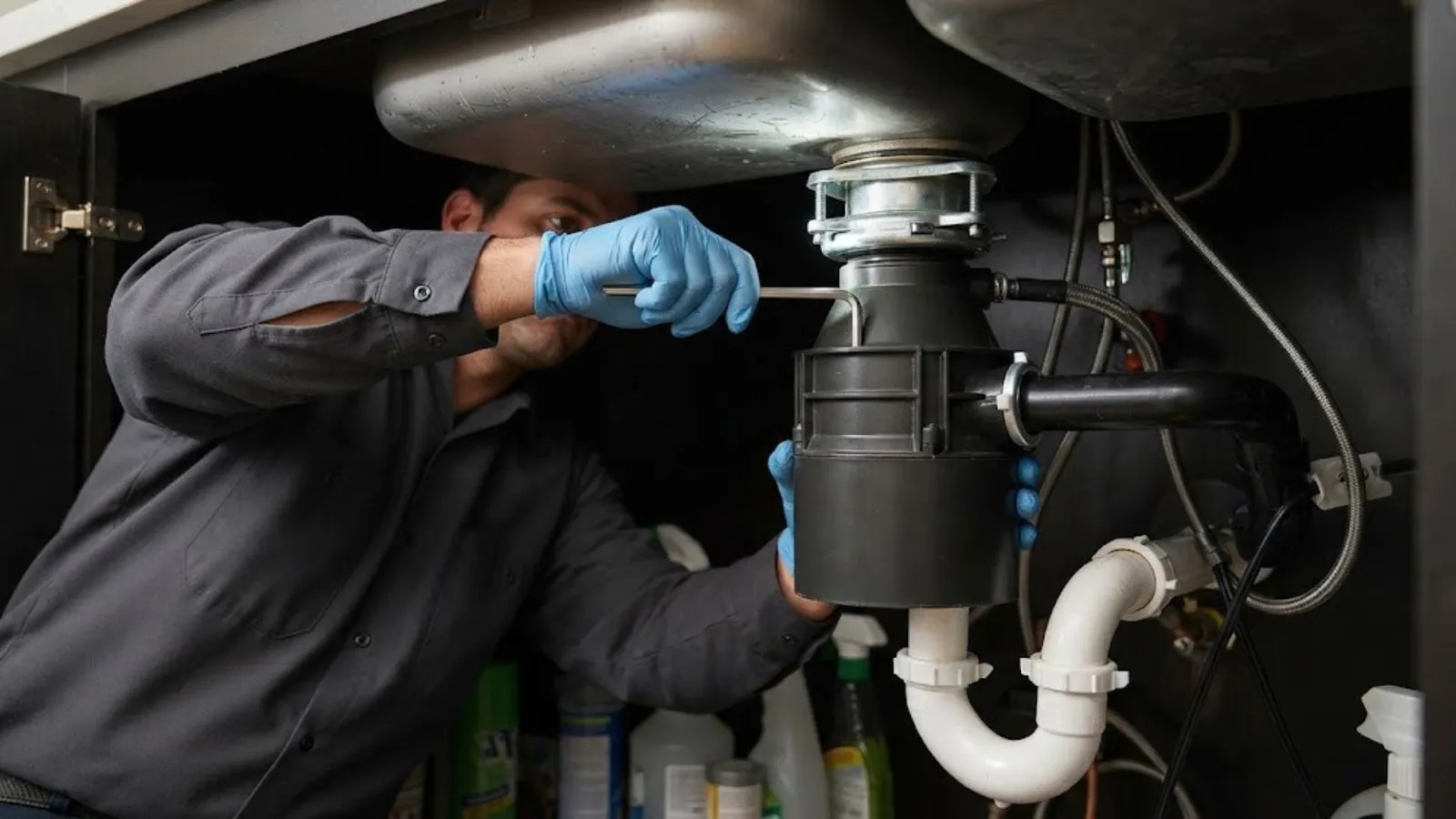
Most garbage disposal repair starts with two checks: free a jammed flywheel with a hex key, and press the red reset button on the bottom of the unit. Do both with the power off, and never put your hand into the grinding chamber. If neither works, the cause is usually a leak, a dead motor or a clog downstream, and that is where a plumber's disposal repair takes over.
This page covers the homeowner steps in the order a plumber would try them, then the signs that mean stop. The goal is to separate a ten-minute fix from a job where DIY makes things worse.
Safety steps before you touch anything
A disposal has a motor and sharp parts. Run through this list every time.
- Turn the wall switch off, then unplug the unit or switch off its breaker.
- Never reach into the opening with your hand, even with the power off.
- Use a flashlight to look down the drain for a stuck item.
- Pull out loose items only with tongs or long pliers.
- Keep the sink water off while you work on the underside.
- Plug the unit back in or restore the breaker only after the checks are done.
Symptom, likely cause and who handles it
The sound the disposal makes tells you most of what you need to know.
| Symptom | Likely cause | DIY or plumber |
|---|---|---|
| Humming, no spin | Jammed flywheel | DIY with a hex key |
| Silent, no hum | Tripped reset, outlet or breaker | DIY checks first |
| Slow draining sink | Clog downstream of the unit | Plumber if it returns |
| Water under the sink | Seal, hose or housing leak | Plumber for the housing |
| Foul smell | Food film on the baffle | DIY cleaning |
| Loud grinding | Foreign object or worn parts | Plumber if it persists |
Hum without spin points to a jam. Total silence points to power. A leak is a different category, because water and electricity share the cabinet.
Freeing a jam with a hex key
Many units have a small hex socket in the center of the underside. The wrench that fits it often shipped in the box, and a standard hex key in the right size also works.
- 1
Cut the power
Switch off and unplug the unit. Confirm it is off by trying the switch.
- 2
Insert the hex key from below
Find the socket in the middle of the bottom plate and seat the wrench fully.
- 3
Work the key back and forth
Turn it one way, then the other, until the flywheel moves freely through a full rotation.
- 4
Remove the stuck item
Look down the drain with a light. Pull out the object with tongs and never with fingers.
- 5
Press the reset button
The red button on the bottom pops out when the motor overheats. Push it in firmly, restore power and test with cold water running.
If it is dead quiet, check power before the motor
A disposal with no hum and no spin is often a tripped breaker, a tripped GFCI outlet or the reset button. Check those in that order. A GFCI outlet may sit in the same circuit as other kitchen outlets, so look for one that has popped.
If the reset button pops back out right away, the motor may be overheating from overload or failing. Let it rest, press the button once more and try with cold water. Repeated trips mean the unit is wearing out, and repair parts for a small motor rarely make sense.
Do not open the electrical compartment or the wiring on the bottom of the unit. That is the point where a plumber or an electrician takes over.
Older kitchen drain lines in Erlanger homes
Erlanger added most of its housing in the 1950s, 1960s and 1970s, and the core is older. In the US generally, drains from those eras were often cast iron, with plastic becoming common from the 1970s on. A pipe inspection shows what this house actually has. Older iron lines tend to have rough interiors that catch grease, so a disposal that keeps clogging may be the first sign.
If your kitchen sink backs up even after the unit is cleared, ask a plumber to look at the branch line. Replacing the disposal will not cure a narrowed pipe. A planned visit also lets the plumber check the trap, the under-sink connections and the dishwasher hookup in one trip.
That advice applies across Kenton County, from Edgewood to Crescent Springs. The house matters more than the zip code, so describe the symptoms and the age of the home when you call.
Source type: City of Erlanger history page and general plumbing materials by era (hedged)
Leak spots and what each one means
Dry the cabinet, run water and watch to find the source. Where the water appears tells you which part failed.
Drips at the top flange
The sink flange seal or mounting ring has loosened. Fixing it means removing the unit, so call a plumber.
Drips at the dishwasher hose
A loose clamp on the dishwasher inlet is a simple tighten and check.
Drips at the discharge pipe
The bolted flange where the pipe leaves the unit may need a new gasket or fresh tightening.
Water from the housing body
A crack or a failed seal in the shell can only be fixed by replacing the disposal.
Repair it or replace it
Repair makes sense for jams, resets and loose connections. Replacement is the better call when the body itself is failing.
Repair makes sense when
- A jam clears with the hex key and the unit runs normally
- A hose or discharge flange leaks and the housing is dry
- The sink drains slowly and the clog is downstream
- The unit is otherwise quiet and strong
Replace when
- The housing is leaking or cracked
- The reset button trips again and again
- The unit grinds loudly even when empty
- Rust is showing on the shell or the mounting ring
A new unit is also the moment to have the installation done properly and to check the drain line and the trap. Hardware that has failed from age often has a drain connection that needs attention too.
What to stop putting down the drain
Grease and oil are the biggest problem, even with the disposal running. They cool and coat the pipe wall farther down the line. Pour them into a can and bin them when it hardens.
Fibrous scraps like celery, corn husks and onion skins wrap around the cutters. Starchy foods like pasta and rice swell and form paste. Coffee grounds settle in the trap and cement together. Bones, fruit pits and eggshell membrane also cause trouble.
Run cold water before, during and for about fifteen seconds after use. That flushes ground food through the trap and into the drain line. Feed small amounts at a time rather than a full load.
Signs the problem is the drain and not the disposal
If the sink fills with gray water and the disposal hums normally, the clog is probably in the trap or the kitchen line. A plunger on the sink and a look at the trap may fix it. If the water backs up again within days, professional drain cleaning reaches farther than a hand tool can.
If the disposal is fine but water rises in other fixtures, the blockage is deeper. Check whether a nearby bathroom sink or a floor drain gurgles. Those are signs of a line problem, not a unit problem.
Quick Answers on Garbage disposal repair
A hum with no spin means the motor is getting power but the flywheel is jammed. Turn off the power, insert a hex key in the bottom socket and work it back and forth to free the blades.
It is a small red button on the bottom of the unit. Press it firmly after the motor cools. If it pops out again right away, the motor is failing or something is jamming it.
Plumbers still advise against it. Use a flashlight and long tongs to pull out an item, and keep fingers out of the chamber.
No. Water collecting in the cabinet damages the floor and the wiring nearby. Turn it off, dry the area and have a plumber find the source.
Yes. The 24/7 line is open at night and on weekends. A leaking unit or a sink full of backed-up water is worth a call, and the plumber sets a clear price before work starts.