
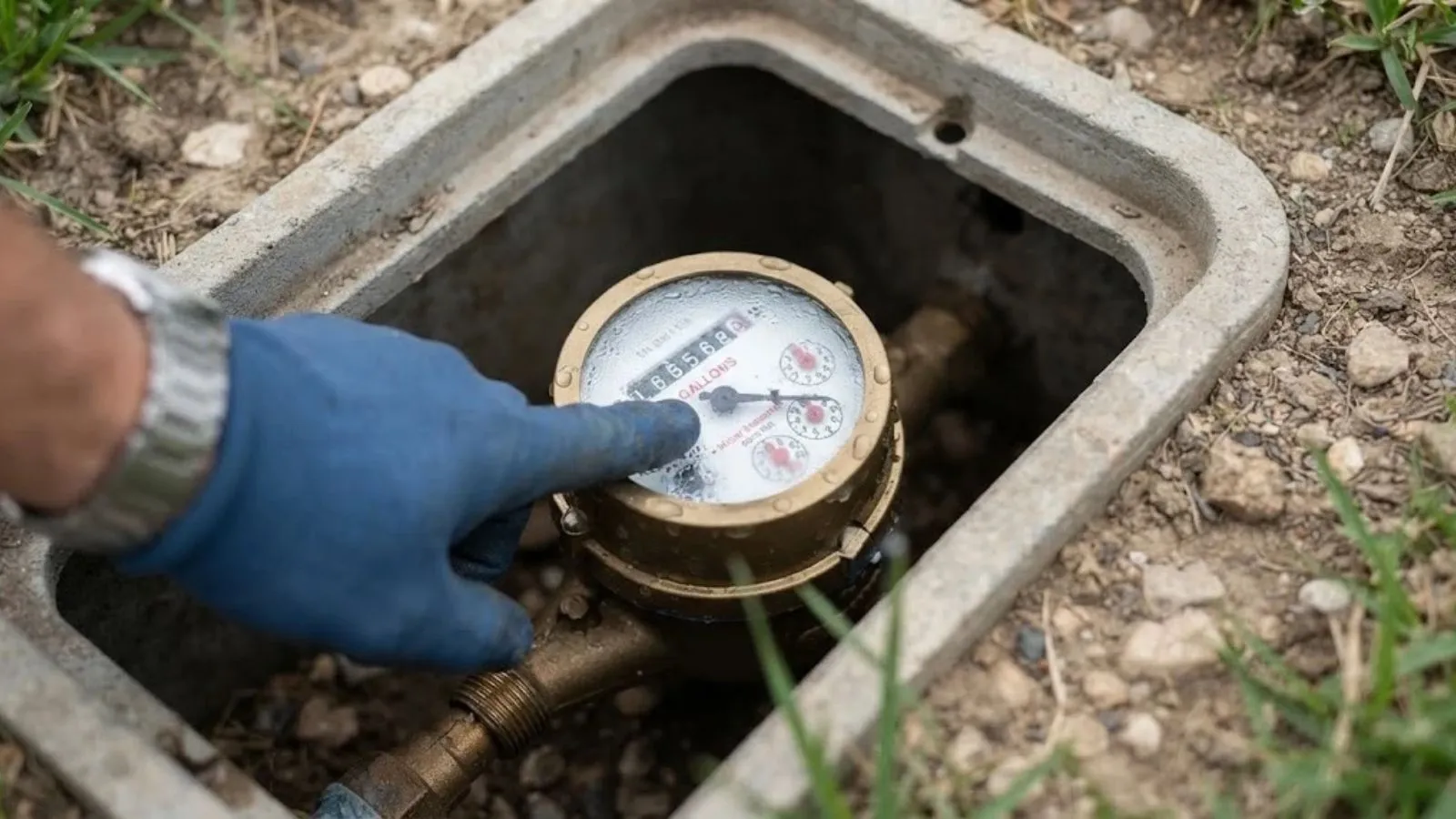
If your water meter keeps moving when every tap, appliance and hose is off, you have a leak. A water bill that creeps up month after month with no change in habits points the same way. The quickest way to be sure is a meter test: shut off everything, read the meter, wait, and read it again.
In Erlanger, KY, the test takes about an hour and needs no tools. Where the meter moves, and whether it stops when you close the main valve, tells you if the leak is inside the house or on the pipe between the meter and the house. Below is the full routine, plus the usual causes to rule out before you call anyone.
The meter test, from first read to final answer
Pick a time when nobody will use water for at least an hour. Early morning or while the house is empty works well.
- 1
Turn everything off
Stop the dishwasher, washing machine and ice maker cycle. Close all faucets. Make sure nobody flushes a toilet during the test.
- 2
Open the meter lid and find the leak indicator
Most meters have a small triangle or star that spins when any water flows. If it turns with everything off, water is moving.
- 3
Write down the reading
Note the numbers on the dial, including the sweep hand. A phone photo works. This is your starting point.
- 4
Wait without using water
Give it at least 30 minutes, and an hour if you can. Slow leaks need time to show on the register.
- 5
Read it again and compare
If the numbers moved, water is leaking. If they did not move, the leak may be small, intermittent, or tied to an appliance cycle.
Closing the main valve to narrow it down
Once the meter shows movement, close the main shutoff valve where the line enters the house. Watch the indicator again. If it stops, the leak is inside the house, past the valve. If it keeps turning, the leak is on the line between the meter and the house, or at the valve itself.
That one step saves a lot of guessing. An inside leak can be at a toilet, a fixture, a water heater connection or a pipe in a wall. A buried line leak means digging or pinpointing equipment, and it often shows as a wet spot or soft ground.
Quiet culprits to rule out before you suspect a pipe
Many high bills come from something running that you can fix in minutes.
- A toilet flapper that leaks into the bowl (add a few drops of food coloring to the tank and wait 15 minutes)
- A hose bib or outdoor spigot dripping or left on
- An irrigation system with a stuck zone valve or a timer that ran more often than you meant
- A water softener that keeps regenerating or draining
- An ice maker or humidifier line with a slow leak
- A water heater relief valve that drips
- A garden hose with the nozzle off and the spigot cracked open
Northern Kentucky Water District and your Erlanger address
Northern Kentucky Water District (NKWD) is headquartered at 2835 Crescent Springs Rd in Erlanger and serves retail customers in Kenton, Boone and Campbell counties. Check your bill to confirm NKWD supplies your address, since service areas do not always follow city lines. Once you know who bills you, you know who to call about the meter reading.
Erlanger's housing grew from 6,865 units in 2000 to 8,249 in 2020, and its fastest growth came in the 1950s, 1960s and 1970s. Homes from that era may have different supply pipe materials. In the US generally, older supply lines were often galvanized steel and later ones copper or PEX, so a leak in an older house deserves a closer look at the pipe itself. A pipe inspection shows what your house actually has.
Nearby towns such as Crescent Springs and Edgewood share the same general question when a bill jumps. Do the meter test first, because it tells you whether to call the utility about the reading or a plumber about the pipe.
Source type: Northern Kentucky Water District filings, City of Erlanger history page and Census data
What the meter is telling you
Match your results below to narrow the list.
| What you see | Likely meaning | Next step |
|---|---|---|
| Meter moves, stops when main valve closes | Leak inside the house | Check toilets, fixtures, heater, then call |
| Meter keeps moving with main closed | Leak on the line outside or at the valve | Call for leak location |
| Meter still, bill is high | Past use, a billing error or intermittent leak | Compare bills, ask about the reading |
| Only a tiny sweep movement | Slow drip or toilet seep | Do the dye test, check fixtures |
| Moves only at certain hours | Irrigation, softener or appliance cycle | Check timers and settings |
A meter test finds that a leak exists and roughly where. It does not pinpoint the spot.
A running meter versus a bill that is simply higher
These two problems have different fixes, so separate them early.
Meter moves with everything off
- Water is leaking right now
- The test above shows it
- Fix is a repair, not a billing talk
- Gets more expensive every day you wait
Bill is high, meter is still
- Use may have been higher in an earlier period
- Guests, a pool fill or watering can explain it
- A misread meter is possible, so compare readings
- Ask the water provider how the reading was taken
EPA WaterSense says household leaks can waste nearly 10,000 gallons a year, and about 10 percent of homes leak 90 gallons or more per day. Small leaks add up quietly.
What a leak detection visit adds to your test
Your test says a leak exists. A plumber doing leak detection finds where it is. That can mean pressure testing sections of pipe, listening with acoustic equipment, or using a thermal camera to trace a hot water line. The tools match the clue you already have, which is why your meter notes help. Repairs range from a worn fixture part to repiping a failing run when the pipe itself is giving out.
Cost depends on factors, not a flat number. These include how far the suspected line runs, whether it is under concrete or soil, how many fixtures need checking, and whether repair is done on the same visit. A plumber should explain the plan and give a clear price before work starts.
Who to talk to about the bill itself
Check your water bill to confirm who supplies your address. If the meter is the utility's, they can answer how the reading was taken and what your usage history shows. Bring your before and after meter numbers with you.
Do not assume a bill adjustment is available, because policies differ and change. Ask the provider directly, and keep any plumber's written findings, since they show what was found and when it was fixed.
Quick Answers on Water meter running high water bill
No. With every fixture and appliance off, the leak indicator should stand still. If it spins, water is flowing somewhere, and the meter test will help you tell whether it is inside the house or on the line outside.
Thirty minutes is the minimum and an hour is better. A slow leak may only move the register a small amount, so a longer wait makes the result clearer.
Yes. A flapper that does not seal lets water trickle into the bowl all day. Add food coloring to the tank, wait 15 minutes without flushing, and see if color shows in the bowl.
Many leaks are hidden in walls, under floors or in buried lines. No visible water does not rule one out. A leak locator can find it without opening everything up.
Northern Kentucky Water District serves retail customers in Kenton, Boone and Campbell counties and has its headquarters in Erlanger. Your bill shows who supplies your address, so confirm there.