
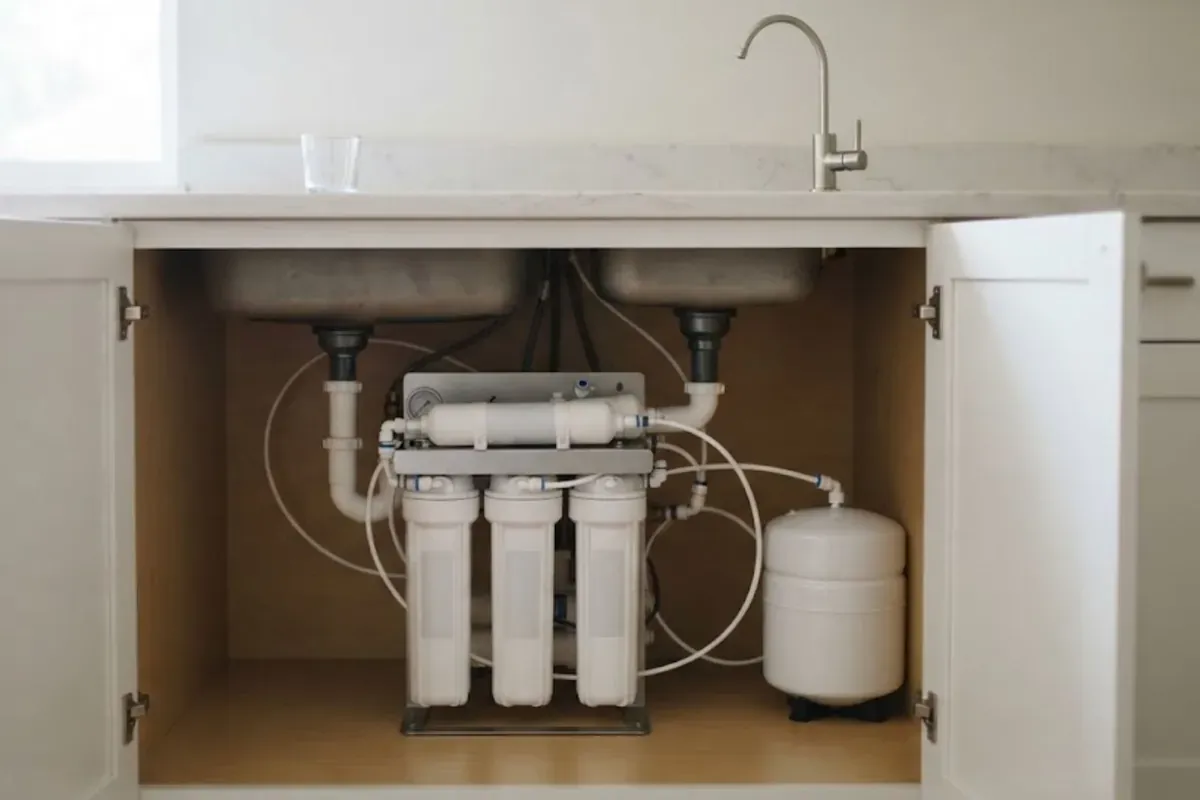
An under sink reverse osmosis (RO) system is a small filter set that sits in the sink cabinet and treats cold water for drinking and cooking. Tap water is pushed through a very fine membrane that holds back dissolved solids, and the clean water collects in a small storage tank until you open the dedicated faucet.
The system needs three things from your plumbing: a cold water connection, a drain connection for the rejected water, and room for the tank and filter housings. Most homes can fit one, and a planned plumbing install usually takes a single visit. The sections below cover how it works, what the install looks like, and what the upkeep costs you in time and parts.
Four stages between the tap and your glass
Most under sink RO units use the same basic path. Water enters from a small valve on the cold supply line and passes through each stage in order.
- 1
Sediment prefilter
A pleated or spun cartridge catches sand, rust flakes and grit so they do not clog the finer stages that follow.
- 2
Carbon prefilter
Activated carbon takes out chlorine and many taste and odor compounds. This stage also protects the membrane, which does not tolerate chlorine well.
- 3
RO membrane
The membrane is a thin sheet rolled inside a tube. Clean water passes through it slowly, and most dissolved solids are carried off to the drain.
- 4
Storage tank and post filter
Treated water waits in a tank that holds a few gallons. A final carbon filter polishes the taste as it flows to the faucet.
What goes in the cabinet and what to check
Every RO kit looks a little different, but the same parts show up. Use this table to see whether your cabinet can host one.
| Part | What it does | What to check at home |
|---|---|---|
| Filter housings | Hold the prefilters and membrane | Clear height to pull a cartridge down |
| Storage tank | Stores treated water under pressure | Floor space or a wall spot nearby |
| Drain saddle | Carries rejected water to the drain | Straight, accessible tailpiece above the trap |
| Feed adapter | Taps the cold supply line | A working shutoff valve on the cold side |
| Dedicated faucet | Dispenses the treated water | A spare sink hole or room to add one |
| Tubing | Links every stage | Clear routing with no sharp bends |
A cabinet crowded with a disposal, a trash pullout and cleaning supplies may need a rearranged layout. Tell the plumber about those items before the visit so the plan fits.
Where the reject water goes and why it matters
RO is not a closed loop. For every gallon of treated water the membrane makes, some larger amount is flushed to the drain to carry away what the membrane rejected. The ratio depends on the unit, the incoming water pressure and the age of the membrane, so read the spec sheet for the model you are considering.
The drain saddle is a clamp that bolts onto the sink drain tailpiece, above the P-trap. A small hole is drilled through the pipe wall, and a tube carries the reject water into it. A poor seal or a hole drilled below the trap weir can leak or let sewer odor back up.
Most kitchen installs also use a faucet with an air gap. That is a small chamber in the faucet body where the drain line breaks the connection with the sink drain. It keeps dirty drain water from flowing backward into the filter, and many installers use one on every job.
Check your NKWD report before picking filter stages
Northern Kentucky Water District serves retail customers in Kenton, Boone and Campbell counties, and its headquarters sits on Crescent Springs Road in Erlanger. Your water bill is the place to confirm who supplies your address. Check it first, so you ask the right utility for the right report.
Federal rules require community water systems to publish an annual water quality report. Ask NKWD for its latest report, or look for the copy it publishes. Read the listed contaminants and note any that matter to your household, then pick filter stages with that list in hand.
A report describes water at the system level, not at your faucet. If you want a reading from your own tap, use a home test kit or ask a lab. That result tells you whether RO is the right tool or whether a simple carbon filter would handle your taste complaint. Neighbors in Edgewood and Fort Mitchell can follow the same steps with their own utility report.
Source type: Northern Kentucky Water District (NKWD) filing and federal consumer confidence report rules
RO system or a pitcher and faucet filter
People often start with a pitcher and wonder whether an under sink unit is worth the cabinet space. The two solve different problems.
Under sink RO system
- Treats water at a dedicated faucet with no refilling
- Uses a membrane that removes dissolved solids as well as taste and odor compounds
- Needs a drain connection, a cold line tap and cabinet space
- Needs several filter changes on a schedule, and the membrane on a longer one
- Best for households that drink and cook with a lot of water
Pitcher or faucet-mount filter
- Needs no plumbing work at all
- Mostly carbon, so it improves taste and odor but does not use a membrane
- Holds a small volume and needs frequent refilling
- Cartridges are small and easy to swap
- Best for renters and for light drinking-water use
Neither option fixes a plumbing problem like a leaking line or a failing water heater. RO is a drinking water tool and nothing more.
How an install goes from start to finish
A straightforward install in a standard kitchen is a planned visit, not an emergency job. Here is the order a plumber usually works in.
- 1
Clear and inspect the cabinet
The plumber empties the space, checks the cold shutoff valve and looks at the sink drain pipe and faucet holes.
- 2
Mount the filter bracket
The housings go on the cabinet wall at a height that lets you pull each cartridge straight down.
- 3
Tap the cold line and the drain
A feed adapter goes on the cold supply, and the drain saddle clamps to the tailpiece after a clean hole is cut.
- 4
Set the faucet
The new faucet goes into a spare hole or a new one. Stone countertops need care, and a hole may be best left to a stone fabricator.
- 5
Flush and leak check
The system runs through a first fill, the plumber discards the initial tank, and every fitting gets checked for drips under pressure.
Questions to settle before you buy a unit
A few minutes of planning avoids buying a kit that does not fit your sink.
- Measure the cabinet width, depth and height with the disposal and pipes in place.
- Count the sink holes and note whether the countertop is stone or solid surface.
- Find the cold shutoff valve and confirm that it turns.
- Decide whether an air gap faucet suits your look.
- Ask the maker how often each filter and the membrane should be changed.
- Decide whether you want a mineral add-back stage for taste.
Upkeep, taste and the things RO will not do
Prefilters protect the membrane, so changing them on time is the main chore. The membrane itself lasts longer than the prefilters, but it does not last forever. A drop in flow at the faucet or a tank that refills slowly is a sign something needs a swap.
RO water can taste flat because most of the minerals are gone. Some people like that and others add a remineralizing stage. Keep in mind that RO is for the drinking tap only, so it does not soften water for the dishwasher, the shower or the water heater.
The feed must come from the cold line, because hot water damages the membrane and housings. If a system loses pressure, floods the cabinet or hisses at the saddle, shut the small feed valve. A weeping fitting might also point to a faucet or supply line fault nearby, so have a plumber look before you keep tightening.
Quick Answers on Under sink reverse osmosis system
Plan for a cabinet footprint a bit wider than a bucket, plus room to pull cartridges down. The storage tank can sit beside the filters or in a nearby cabinet, as long as the tubing reaches.
Yes. The membrane sends rejected water to the drain, so the unit needs a saddle on the sink tailpiece and a tube to carry it. Without a drain line it cannot work.
Usually yes. The saddle goes on the section between the sink and the trap, and a disposal sits on the sink side. The plumber checks clearances first so the saddle and the disposal do not collide.
No. RO only treats the line to its own faucet. The rest of your plumbing, including the water heater, still gets regular tap water.
Ask Northern Kentucky Water District for its annual water quality report, and check your water bill to confirm that NKWD supplies your address. The report is the starting point for choosing filter stages.