
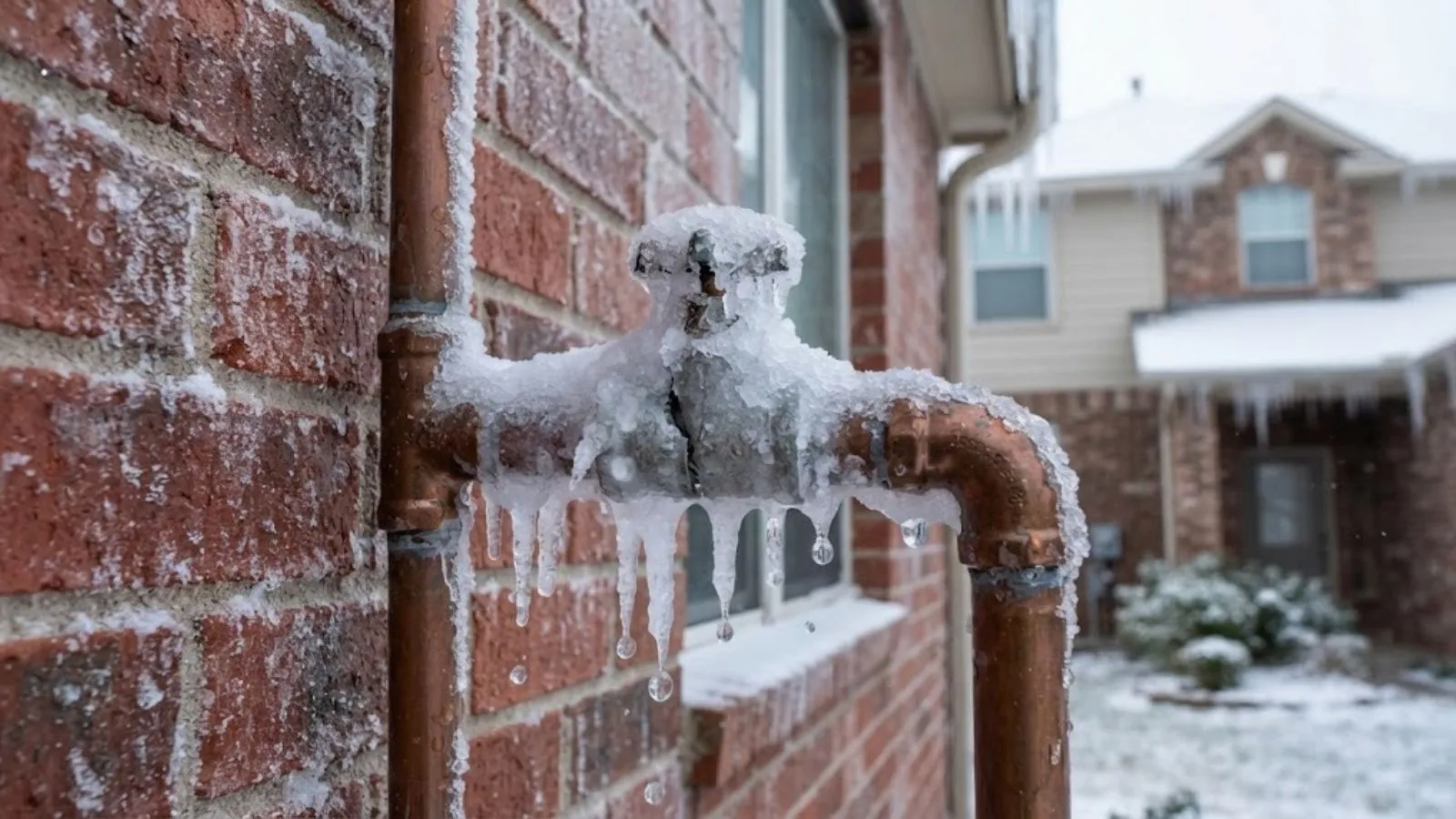
If a faucet gives you a trickle or nothing at all and the temperature has been low, a pipe may be frozen. Act quickly. Open the faucet a little, find and close the main water shutoff, and start thawing the pipe gently with warm air. If you see water, a bulge or a split, leave the valve closed and call the 24/7 line.
The thaw is only half the job. Ice expands and can crack a pipe where you cannot see it, so the leak often shows up after the pipe warms. Below are the safe methods, the unsafe ones, and how to check for damage afterward.
The first ten minutes, in order
Speed matters, but order matters more. These steps reduce the risk of a flood and a bigger repair.
- 1
Find the main shutoff
Know where it is before you need it. If a pipe has already split, close it immediately to stop water flowing.
- 2
Open the affected faucet
Leave it slightly open. As the ice melts, water and pressure need a way out.
- 3
Locate the frozen section
Frozen pipes feel cold and may show frost. Common spots are outside walls, unheated spaces and pipes near vents or gaps.
- 4
Keep power away from water
Do not use electrical tools or run cords near wet areas. If water is near outlets or the panel, stay clear and call for help.
- 5
Start thawing gently
Use warm air, working from the faucet end back toward the frozen section so the melt can drain out.
Safe thawing methods versus ones to skip
How you thaw matters. Fast heat can damage the pipe or start a fire, and the wrong tool can leave you with a leak that appears later.
Reasonable to try
- A hair dryer on low, moved back and forth
- A heating pad wrapped around the pipe
- Towels soaked in warm water
- Raising the room temperature with a space heater placed safely away
- Opening cabinet doors so warm air reaches the pipe
Never do these
- Use an open flame or torch
- Leave a heat source unattended
- Pour boiling water on the pipe
- Use a heater near wet surfaces or standing water
- Keep heating after you hear hissing or see a split
Flame is risky because it can ignite framing and insulation. It can also overheat the pipe or the joints on the other side of the wall.
Signs a frozen pipe has already cracked
The damage often hides until the ice melts. Watch for these signals during and after thawing.
Water appears as the pipe warms
A drip or spray that begins during thaw usually marks the split. Close the main valve.
A bulge or swollen section
Pipe that has stretched has weakened, even if it has not leaked yet. Plan on replacing that section.
Stains or damp spots on walls
A wet patch near the frozen run means water is escaping inside the cavity.
Hissing sounds inside a wall
A thin sound of moving water with every tap closed points to a leak under pressure.
Meter running with fixtures off
If your meter keeps moving after you shut every tap, there is a leak somewhere in the lines.
Low pressure after the thaw
A partial blockage or a crack can both cut flow. Run a few fixtures and compare.
Permits, drains and who to call in Erlanger
Under Kentucky's 815 KAR 20:050, repairing leaks, cocks or valves does not need a plumbing permit. A split pipe repair generally falls in that category, so you should not expect paperwork to slow down an emergency fix. Replacing a house sewer or water service is different, so ask your plumber which kind of work you are facing.
Erlanger's homes range from houses in the early core, between Riggs Avenue and Crescent Avenue, to subdivisions built in the 1950s through 1970s boom. Pipe materials differ by era, so hedge your expectations. A pipe inspection will show what your house has before anyone cuts into a wall.
Service reaches nearby towns too. Homeowners in Elsmere and Fort Mitchell can reach the same 24/7 line, and verifying a plumber's license with the state Division of Plumbing is a smart move anywhere.
Source type: Kentucky 815 KAR 20:050, Kentucky Division of Plumbing, City of Erlanger history page
Pipe types and how they handle a freeze
Material affects how a freeze plays out. This is a general guide, and the pipe in your own wall may differ.
| Pipe material | How it reacts to a freeze | Usual repair |
|---|---|---|
| Copper | Often splits along a seam | Cut out and replace the section |
| Galvanized steel | Cracks at weakened threads | Replace a longer run |
| PEX | Stretches more, may survive | Inspect and replace if damaged |
| CPVC | Brittle, can shatter | Replace the affected run |
| PVC drain | Cracks if water freezes inside | Replace the cracked section |
| Outdoor hose bib | Valve or pipe behind it splits | Replace the spigot or valve |
A camera or pipe inspection shows what this house actually has, so treat the table as a general guide, not a verdict on your plumbing.
What a plumber does that a hair dryer cannot
A plumber can find the freeze when you cannot. Thermal tools, access cuts and a careful look at the pipe run reveal the frozen section, and a pressure test shows whether the thawed pipe holds. That is the step most homeowners skip, and it is why repairs sometimes fail a day later.
If a pipe split, the repair depends on where it sits. A short section can be cut out and replaced with a coupling or new pipe. A long run, or a split inside a wall, needs access and sometimes a wall opening, which is a larger job.
Honest limits apply here. A plumber fixes the plumbing, but drying out a soaked wall, flooring or insulation is a separate task for a restoration crew. Ask what is included before the visit.
After the thaw, before you relax
A pipe that flows again is not necessarily a pipe that is fine. Run these checks for the next day or so.
- Turn the main back on slowly and listen for hissing
- Check under sinks and along the frozen run for drips
- Look at the ceiling below any upstairs pipes
- Watch the water meter with every tap closed
- Keep the faucet dripping slightly if the cold continues
- Open cabinet doors on outside walls to keep pipes warm
- Call a plumber about any pipe that bulged or leaked
Quick Answers on Frozen pipe repair
A frozen supply pipe affects water coming in, often at several fixtures, and usually follows a cold spell. A clog affects drains and shows as slow draining. If cold water barely flows, think freeze first.
Many plumbers suggest closing the main if you cannot watch the pipe while it thaws, because a hidden split will flood once flow returns. At minimum, know where the valve is and be ready to close it.
No. Open flame and high heat can ignite framing, damage joints and make a pipe burst. Use a hair dryer, a heating pad or warm towels, and never leave heat unattended.
Close the main shutoff, keep clear of wet electrical areas and call the 24/7 line. A crew handling burst pipe repair can cut out the split and restore water, but wet drywall and floors need separate drying.
Yes. The line is open 24/7, and same-day appointments are offered when available. Close the main valve, open a faucet, keep clear of standing water near outlets and call. Leak detection can help if the source of a leak is not obvious.